Far North Waters bottlenose dolphin PhotoID catalogue

TriOceans has spent 8 years curating a photoID catalogue for bottlenose dolphin in Far North Waters and can track how the population parameters evolve.

PhotoID (short for photo identification) is used by researchers to track bottlenose dolphin movements, social networks and habitat preferences. Each fin is unique like a human fingerprint, enabling individual movements to be tracked with minimal disturbance.

Read more

Chatty dolphins

Dolphin acoustics

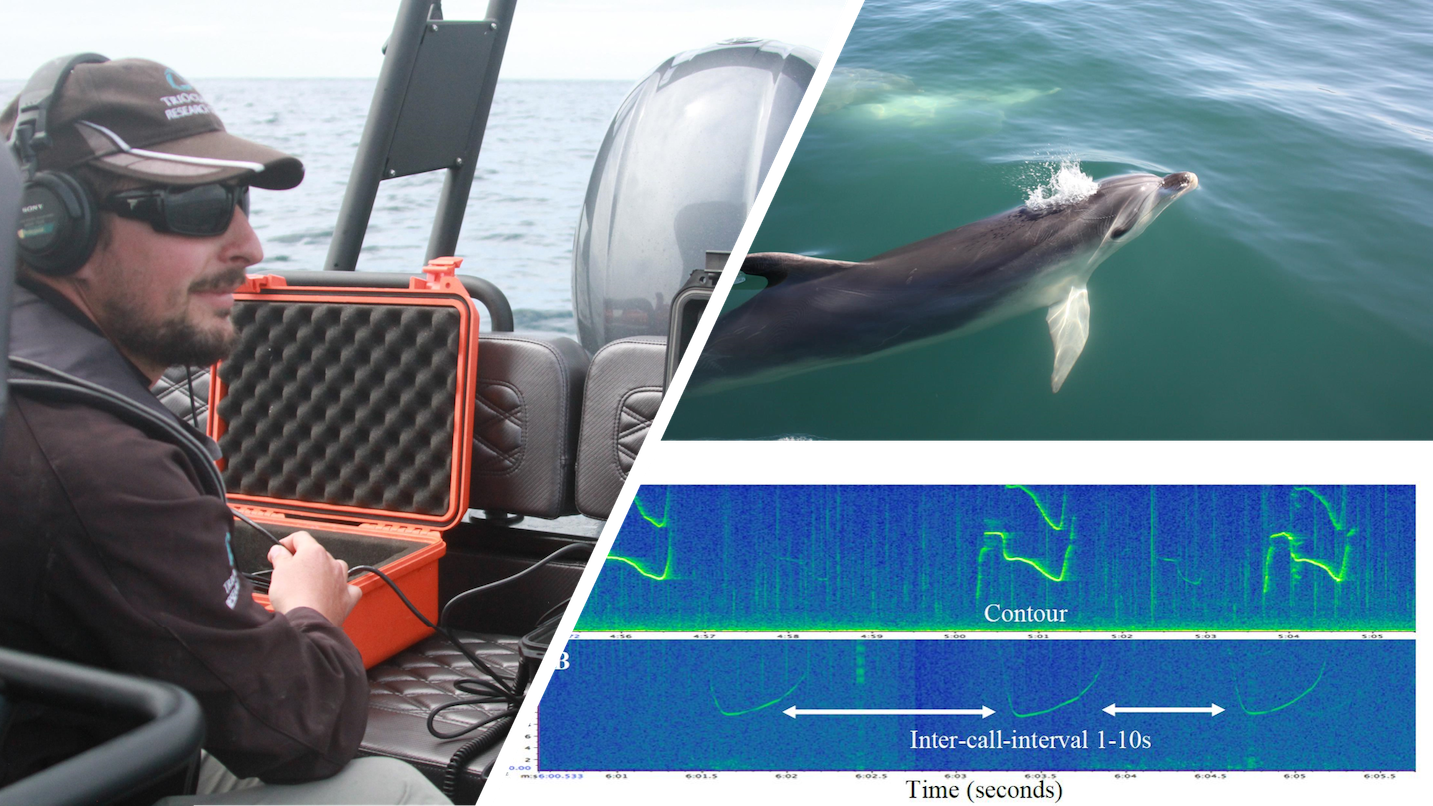
Dolphins communicate with whistles, clicks and buzzes. In a world where visibility is rarely more than a few meters, sound is the way to go to find each other… or other species!

Similarly to bats, dolphins use echolocation to precisely detect their prey. That is the reason behind their bulbous head: a sac of oil called the melon helps produce their whistles and clicks.

Little is known about the significance of each sound… however, we do know dolphins use something similar to a name: the “signature whistle”. Each individual dolphin has its own signature whistle, and calves will often imitate their mothers’, with their own unique tempo of course!

Read more

Behavioural assessment: Marine mammal behaviour budget and transitions – Markov Chains


Markov chains are used to assess how the behaviour of marine mammals changes across a range of variables (depth, group size, presence of calves or vessels…). Results indicate bottlenose dolphins spend less time feeding and resting, but more time milling and socialising in the presence of vessels. This work follows from a Massey unviersity study conducted in 2016 – https://www.doc.govt.nz/globalassets/documents/conservation/marine-and-coastal/bottlenose-responses-dolphin-vessel-activity-northland.pdf  

TriOceans helps pilot whales - NZ herald article

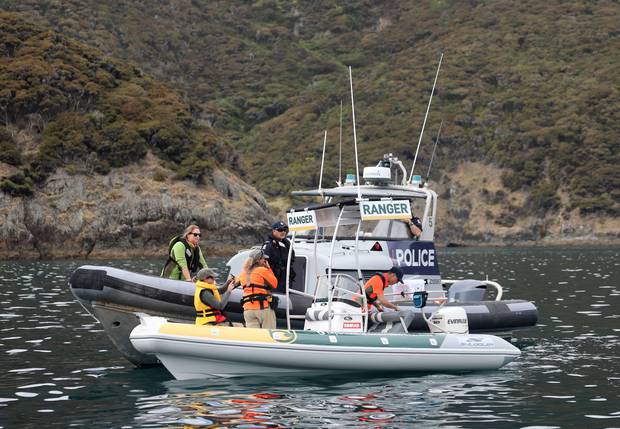
TriOceans helps DOC and Maritime Police with crowd control and monitoring of a pregnant pilot whale as she gives birth.

Crowd control for a pilot whale giving birth was a first for Sergeant Garry Larsen who is patrolling the Bay of Islands as part of the Police Maritime Unit.

And the experienced officer with 20 years in the maritime unit said the “unique callout” was definitely a better work story.

A team of officers have been in the Bay of Islands over the busy Christmas and New Year period carrying out routine tasks such as checking for lifejackets and warning boaties about their speed. But it seems their brief has been extended to crowd control for birthing whales.

DoC and police working together at Deep Water Cove in the Bay of Islands to keep boaties clear of a pilot whale giving birth. Photo / T.Guerin TriOceans

A pod of about 20 pilot whales swam into Deep Water Cove, 6km southwest from Cape Brett in the Bay of Islands, about 8am on Wednesday.

At first boaties in the area, where the Canterbury wreck is located, thought the pod was about to strand.

The police patrol and Department of Conservation staff were contacted and were on the scene about 10am.

“One of the whales was calving so we had to keep the boaties away. We had to stop one vessel heading over to the pod and getting too close and direct them away,” Larsen said.

Dr Cat Peters, a marine mammal ranger based in the Bay of Islands, said the pod were displaying behaviours consistent with stranding as they were bunching together and rolling on their backs.

But on closer inspection they discovered one of the females was calving.

“We witnessed the birth and got to see the baby while they hung around for about half an hour after. Then they headed at some speed out to the deep water.”

The distance is 50m from pilot whales and at least 200m away from any baleen or sperm whale mother and calf.

While not on whale duties the police team, in a rigid-hulled inflatable boat usually based in Auckland, have been checking boaties have been wearing lifejackets and keeping to speed limits.

TriOceans helps pilot whales – NZ herald article

Oceanic bottlenose dolphin (tursiops truncatus), false killer whales (pseudorca crassidens) and pilot whales (globicephalia melas)

Did you know not all bottlenose dolphins are the same?

Two ecotypes can be found here: a coastal and a pelagic (or offshore) bottlenose dolphin. While not different enough to be classified as separate species, those two “groups” do not mix, and the TriOceans team even assisted in a study identifying they use slightly different whistles. So how can you tell the difference? Look for circular scarring along their flanks: these scars come from the cookie cutter shark (Isistius brasiliensis) and are only seen on the pelagic individuals. The pelagic ecotype remains widely unknown, however it does seem to be of a friendly nature: they are often seen in association with pilot whales or false killer whales. In fact, false killer whales in New Zealand have never been seen without pelagic bottlenose dolphins around! The video above was recorded during scientific research in Northland and shows the close association between 2 different species. Don’t forget to turn your sound on! Can you hear the difference between the 2 species?

Large orca tangled in crayfish line in Northland - Stuff article

An expert crew has spent Christmas eve trying to free a large male orca that has become tangled in a crayfish line in Northland.

Department of Conservation said it received a report of the incident in the water off Tutukaka on Monday night.

An expert crew headed to the scene at first light on Tuesday and located the orca, a spokeswoman said.

The crew tried to disentangle it from the crayfish line.

The spokeswoman said an orange buoy was attached to the line, but there was no crayfish pot.

She said boats were asked to stay at least 50 metres away from both the whale and the DOC crew as they needed room to help the orca.

People were also asked to stay out of the water.

Three other orcas were with the tangled whale, she said.

Shortly before 7pm, the decision was made for the crew to leave the water for the day the spokeswoman said.

“We managed to get the orca hooked twice, but it rolled away from us, we were unable to free it.”

“It was an amazing team effort from DOC, coastguard and trioceans. We will continue to be on call and hope to be successful another day.”

Earlier this year, a humpback whale also managed to get itself stuck in a craypot line.

The whale, first spotted at Knife and Steel Harbour, between Big River and Waitutu River in Southland, by a fishing vessel, was believed to be tangled in craypot line trailing up to 30 metres behind it.

“People seeing the whale can assist our rescue response by staying with the whale, monitoring it and advising of its exact location for our disentanglement team to get to it,” DOC ranger Mike Morrissey said in a statement.

The department warned against boaties trying to cut off lines and floats attached to the whale, as it is “very dangerous” and could make it more difficult for the whale and the rescue team.

Large orca tangled in crayfish line in Northland – Stuff article

Little blue penguin (eudyptula minor) distribution

Kernel density maps of little blue penguins in the Bay of Islands

The TriOceans team drives pre-planned transect lines to cover Far North waters evenly whilst searching for target species. This allows for reliable population and distribution estimates. Amongst those recorded are the little blue penguin, allowing us to build an 8 year database of their daytime movements. 

Little blue penguins are found throughout Far North waters, yet they remain largely unstudied 

Read more